
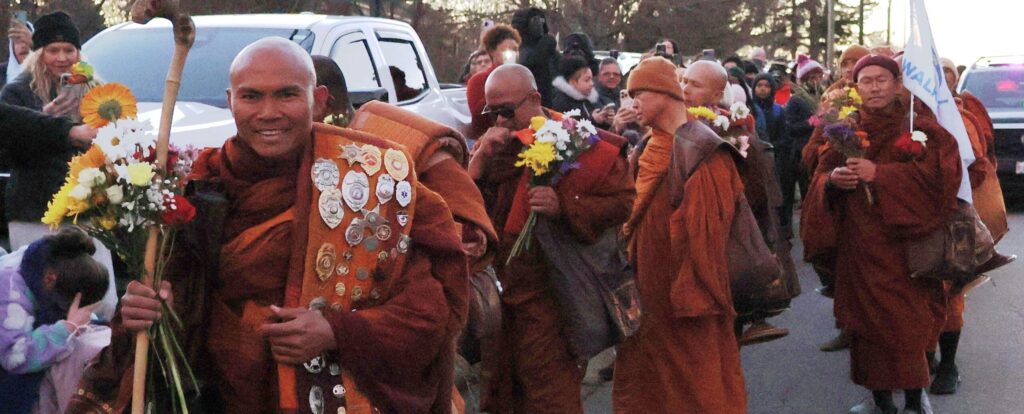
Photo Credits: By Anonymous – Private correspondence, CC BY 4.0
When I first heard about the Buddhist monks walking for peace, something inside me paused.
A 2300-mile journey.
From Texas to Washington DC.
On foot.
Not for recognition. Not for politics. Not for personal gain.
But for a simple message — peace for all.
In a world that often feels divided and hurried, this act feels both radical and deeply familiar. Because at its core, the message of these Buddhist monks walking for peace echoes what yoga has been teaching us all along — heal yourself, become one with yourself, and extend compassion outward.
Their journey is not just about distance. It is about intention.
Who Are the Buddhist Monks Walking for Peace?
The Buddhist monks walking for peace began their 2300-mile pilgrimage from Texas to Washington DC with one intention — to promote healing, unity, and compassion for humanity.
This is not the first time monks have undertaken such pilgrimages. Walking meditation has long been a part of Buddhist practice. It cultivates mindfulness, humility, and connection.
Organizations like the Plum Village Tradition founded by Thich Nhat Hanh have long emphasized walking meditation as a path to embodied peace.
🔗 https://plumvillage.org/mindfulness-practice/walking-meditation/
But this journey feels different in scale.
Two thousand three hundred miles is not symbolic. It is physically demanding. It requires surrender, endurance, and faith.
And yet, the message remains simple:
Peace begins within.
The Message of Buddhist Monks Walking for Peace
Peace for All
The Buddhist monks walking for peace are not asking for complicated reforms. Their message is profound in its simplicity.
- Heal yourself.
- Be compassionate.
- Live in unity.
They remind us that peace is not an external negotiation. It is an internal state.
When inner conflict softens, outer conflict begins to shift.
This mirrors the foundational teachings of Buddhism — reducing suffering through awareness and compassion. The Dalai Lama has often spoken about universal responsibility and compassion as the foundation of global peace.
🔗 https://www.dalailama.com/messages/compassion
The monks are not preaching loudly. They are walking quietly.
That silence speaks.
The Challenges They Chose to Endure
Walking 2300 miles is not comfortable.
It means:
- Blisters and physical fatigue
- Extreme weather conditions
- Uncertainty about shelter and rest
- Long days on unfamiliar roads
The Buddhist monks walking for peace chose discomfort willingly. This is what makes the act so powerful.
There is no personal reward waiting at the finish line. No medal. No applause guaranteed.
Only the possibility that their footsteps might touch hearts along the way.
This is a selfless act for humanity.
It reminds me that real transformation often requires discipline and endurance — not in a harsh way, but in a devoted way.
How This Journey Reflects What Yoga Teaches Us
When I reflect on the Buddhist monks walking for peace, I cannot help but see the parallels with yoga.
Yoga teaches us:
- Heal yourself first.
- Become aware of your inner fluctuations.
- Cultivate compassion toward your own body.
- Extend that compassion outward.
In the Yoga Sutras of Patanjali, Patanjali speaks about calming the fluctuations of the mind. When the mind becomes steady, suffering reduces.
Isn’t that also peace?
Not just the absence of war — but the absence of inner turmoil.
You may enjoy reading more about this connection in reflections on the Yoga Sutras here:
🔗 The Yoga Sutras: The Science of the Mind, Body, and Spirit
Yoga begins on the mat. But it does not stay there.
Just like the monks’ meditation does not stay in a temple.
Walking Meditation and Yogic Stillness
Movement as Prayer
The Buddhist monks walking for peace are practicing walking meditation.
Each step is mindful. Each breath intentional.
Yoga offers something similar.
Whether through slow Yin practices or conscious breathwork, we learn to:
- Move with awareness
- Sit with discomfort
- Observe without reacting
In another reflection on slow practices, we explored how stillness heals deeply:
🔗 Benefits of Slow-Paced Yin Yoga for Deep Rest & Healing
Both paths teach us that peace is practiced. Not demanded.
The Journey Inspires Kindness — To Others and Ourselves
This pilgrimage does more than inspire kindness toward others.
It reminds us to be kind to ourselves.
The monks walking for peace show us devotion. But not aggression. Discipline. But not force.
Yoga invites the same balance.
We push gently.
We release softly.
We observe patiently.
When we become compassionate toward our own body, our own thoughts, our own imperfections — unity begins within.
And from that place, unity extends outward.
Why the Message Feels So Familiar
When I hear about the Buddhist monks walking for peace, it does not feel foreign.
It feels like an extension of the yoga path.
Heal yourself.
Be aware.
Choose compassion.
Act from unity.
The monks’ footsteps across 2300 miles are a living reminder that peace is not passive.
It is practiced daily.
Sometimes quietly.
Sometimes through endurance.
Always through intention.
A Gentle Closing Thought
The world does not only need louder voices.
It needs steadier hearts.
The Buddhist monks walking for peace remind us that transformation begins within and radiates outward. Their 2300-mile journey is not just about reaching Washington DC. It is about awakening consciousness along the way.
Yoga teaches us the same truth.
Peace is not somewhere else.
It begins with us.
Leave a Reply